The Anvil
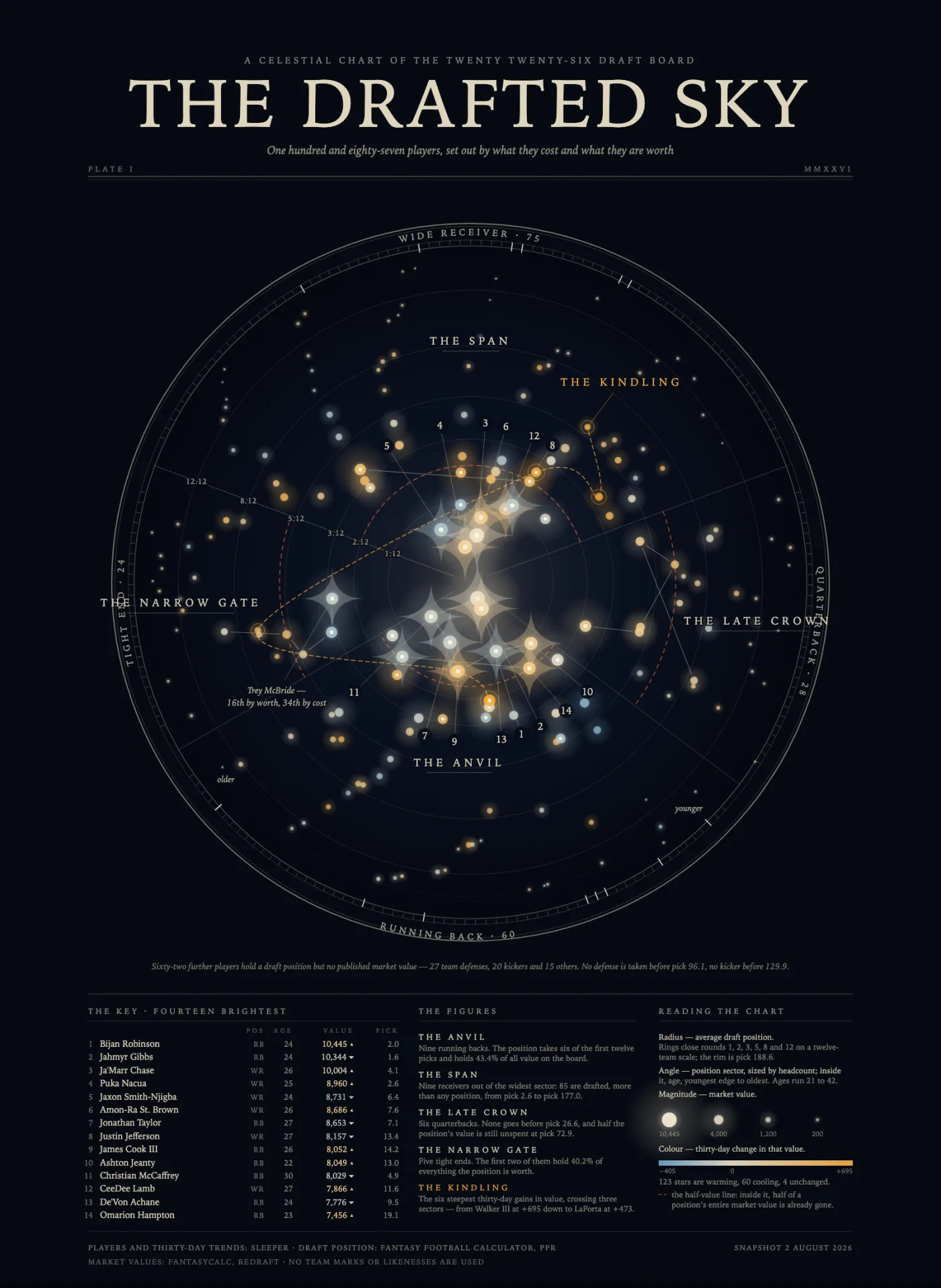
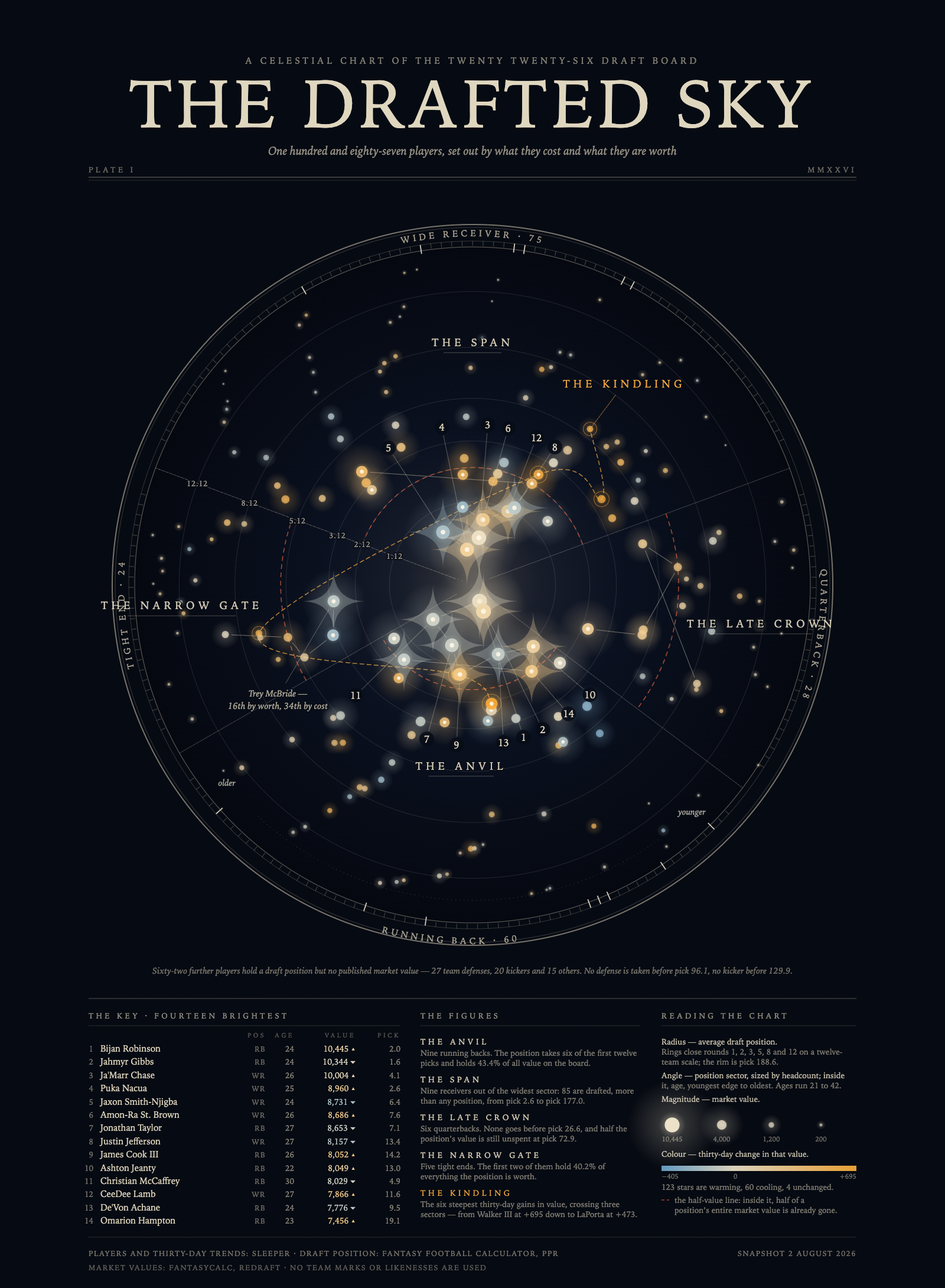
43.4% of the boardSixty running backs are drawn into the sector below the pole, and they hold 43.4% of all market value on the board — 175,804 of 405,352. The position takes six of the first twelve picks, and receivers take the other six. Nothing else is drafted in the first round at all.
The Span
2.6 → 177.0The widest sector on the sheet. Eighty-five receivers carry a draft position, more than any other position, running from pick 2.6 to pick 177.0. Seventy-five of them also carry a published market value, and only those seventy-five can be drawn.
The Late Crown
Nothing before 26.6The quarterback sector is empty across its first two rings. No quarterback is drafted before pick 26.6, and half of the position's entire market value is still unspent at pick 72.9 — the deepest half-value crossing of the four.
The Narrow Gate
40.2% in two starsTwenty-four tight ends occupy the narrowest sector, and the brightest two of them hold 40.2% of everything the position is worth — 13,002 of 32,370. Nothing at the position goes before pick 34.0.
The half-value line
19.1 · 24.0 · 63.4 · 72.9The broken vermilion arcs mark, for each position, the pick at which half of that position's market value has already left the board. Running back crosses at 19.1 and receiver at 24.0; tight end holds out to 63.4 and quarterback to 72.9.
The Kindling
+695 down to +473The six steepest thirty-day gains in value, crossing three sectors: Kenneth Walker III at +695, Terry McLaurin +620, DeVonta Smith +579, Chase Brown +552, Christian Watson +476 and Sam LaPorta +473. Across the whole sky 123 stars are warming, 60 cooling and 4 unchanged.
The fourth variable
A star's place on that sheet is fixed by three measurements and one concession. Radius is what a player costs. Magnitude is what he is worth. Colour is which way his worth has moved. The fourth reading — the angle inside a position's sector — is age, and age is very nearly independent of everything else on the plate. Re-run for this page, the rank correlation between age and draft position is −0.08 across the 187 charted, and −0.10 among running backs.
A quarter of the composition was a spacing device wearing the clothes of a variable. The sheet cannot be altered — it is a print, and it concedes the point in its own key. A page can turn that one dial, and the rest of this one does.
Movement II · one variable changed
The sky, re-plotted
The same 187 stars, the same radius, the same magnitude, the same colour. The angle now carries the distance between a player's rank by market value and his rank by draft cost — the gap between what he is worth and what he costs. Trey McBride is 34th by cost and 16th by worth; on the printed sheet that fact needed a hand-drawn label, and here it is simply where he is standing.
Bijan RobinsonRB · ATL
- pick
- 2.0
- value
- 10,445
- 30-day
- +54
- by cost
- 2nd
- by worth
- 1st
- gap
- +1 late
Pointing at a star names it. ← → walk the board outward from the first pick.
The four readings
187 starsRadius is still average draft position; six rings close rounds 1, 2, 3, 5, 8 and 12 of a twelve-team board — three of them numbered — and the rim is pick 188.6. Magnitude is still market value, colour still the thirty-day change in it. Only the angle is new: inside each sector a star swings from the premium edge, where a player is bought ahead of his worth, to the discount edge, where he is not.
The agreed core
4.5 places apartThe first twelve picks gather along the hairline of agreement in their sectors. Across the first twenty picks the mean distance between a player's rank by cost and his rank by worth is 4.5 places, and fifteen of the twenty are within five. At the top of the board the room and the market are looking at the same thing.
The widening
4.5 → 28.6Agreement does not survive the third round. The mean gap by twenty-pick band runs 4.5, 7.0, 11.0, 16.4, 13.9, and then 28.6 across picks 101–120. Forty-three of the 187 stand twenty-five or more places from their own price. The gaps sum to nought: every place a player is bought below his worth is a place some other player is bought above it.
The receiver premium
57 of 75The widest sector leans hard to its premium edge. Fifty-seven of the seventy-five charted receivers are drafted ahead of their rank by market value, a mean gap of −11.3 places. Tre Tucker is the far edge of the sky: 131st by cost, 187th and last by worth, −56.
The late crown and the narrow gate
38 of 52Quarterback and tight end lean the other way. Thirty-eight of their fifty-two charted players are bought behind their worth — a mean of +10.0 places at quarterback and +11.7 at tight end. Cam Ward holds the sky's far discount edge at +49, with Patrick Mahomes and Tucker Kraft two places behind at +47.
The Kindling
123 warming · 60 coolingColour is the one reading that does not come off the draft board at all. 123 of the 187 gained market value across thirty days, 60 lost it and 4 did not move. The six steepest gains are lit here; they cross three sectors, and not one of them is a first-round pick.
The fourteen brightest
Every one of the fourteen sits within six places of its own price: at the top of the board the room and the market agree. Value is FantasyCalc's redraft market value. Gap is rank by cost minus rank by worth among the 187 charted — positive is bought later than his worth, negative is bought ahead of it. Hovering a row lights that star in the sky above.
Reading the re-plot
Radius — what he costs
Average draft position, PPR, twelve-team. The pole is pick 1.6 and the rim is pick 188.6. The scale is a power curve with a gentler exponent than the print's, so the first round takes the inner third of the radius and the brightest stars separate instead of piling into one core.
Angle — the gap
Rank by draft cost minus rank by market value, over the same 187. One domain is shared by all four sectors, running −56 to +49, and the hairline inside each sector is a gap of nought. Sectors keep the print's widths, so a place subtends more angle in a narrow sector than in a wide one: read the lean of a sector, not the degrees.
Magnitude — what he is worth
FantasyCalc redraft market value, from 10,445 at Bijan Robinson down to 2 at Tre Tucker. Area scales on the square root of value, and the glow is capped so that the brightest stars cannot merge into one blaze.
Colour — which way the money moved
Thirty-day change in that value: cold blue at −405, cream at nought, amber at +695. The four vermilion arcs are the half-value crossings, one to a position.
What is measured and what is drawn. Radius, magnitude and colour are each one measured column. The angle on this page is arithmetic over two of them — a rank subtracted from a rank — and so it is not independent of the other readings; it is the difference between them, made visible. Sector widths are each position's share of the 187 charted. The angular gaps between sectors, the rim ticks and the pole mark carry nothing.
The one invented quantity. Stars that share a rank gap would land on the same angle, so each is nudged by a fraction of a place. The nudge is a hash of the player's Sleeper id, not a random number, so the chart draws pixel-identically every time it is opened, on every machine.
The named figures on the print are editorial. The Anvil, The Span, The Late Crown and The Narrow Gate are chains chosen by hand from each sector's leading players and then joined nearest-neighbour. They are a reading of the sky, not a structure found in it. The Kindling is different: its six members are the six steepest thirty-day gains, which is a query result — only the line drawn between them is a device. The re-plot draws no figures at all.
Scope. PPR average draft position from Fantasy Football Calculator; redraft market values and thirty-day trends from FantasyCalc; identity, position and age from Sleeper; joined on Sleeper id. Sixty-two further players hold a draft position but no published market value — 27 team defenses, 20 kickers and 15 others — and cannot be placed on a chart whose magnitude is value. No defense is taken before pick 96.1, no kicker before 129.9.
Where these numbers come from
Sources & freshness
- FantasyCalc — redraft values & 30-day trend02 Aug 06:56
- FantasyFootballCalculator — ADP02 Aug 05:31
- Sleeper — player universe02 Aug 05:31
- Sleeper — NFL season state02 Aug 06:56
The queries
The plate carries ten statements in its own HTML header — Q1 the 187 charted stars, Q2 the half-value line, Q3 position share of value, Q4 the two tight ends, Q5 the uncharted 62, Q6 the first twelve picks, Q7 the Kindling, Q8 the sentiment split, Q9 the receiver extremes, Q10 the as-of date. Every one was re-run against the snapshot for this page, and every one reproduces.
This page adds two. Q11 ranks the same 187 by cost and by worth and takes the difference — the angle of the re-plot, and every gap figure quoted above. Q12 is the Spearman rank correlation between age and draft position, by position and overall.
The rails
- Every printed figure is query output.
- No league marks, logos, or photographs.
- Nothing is fetched at view time.
- Deterministic: seeded hash only.