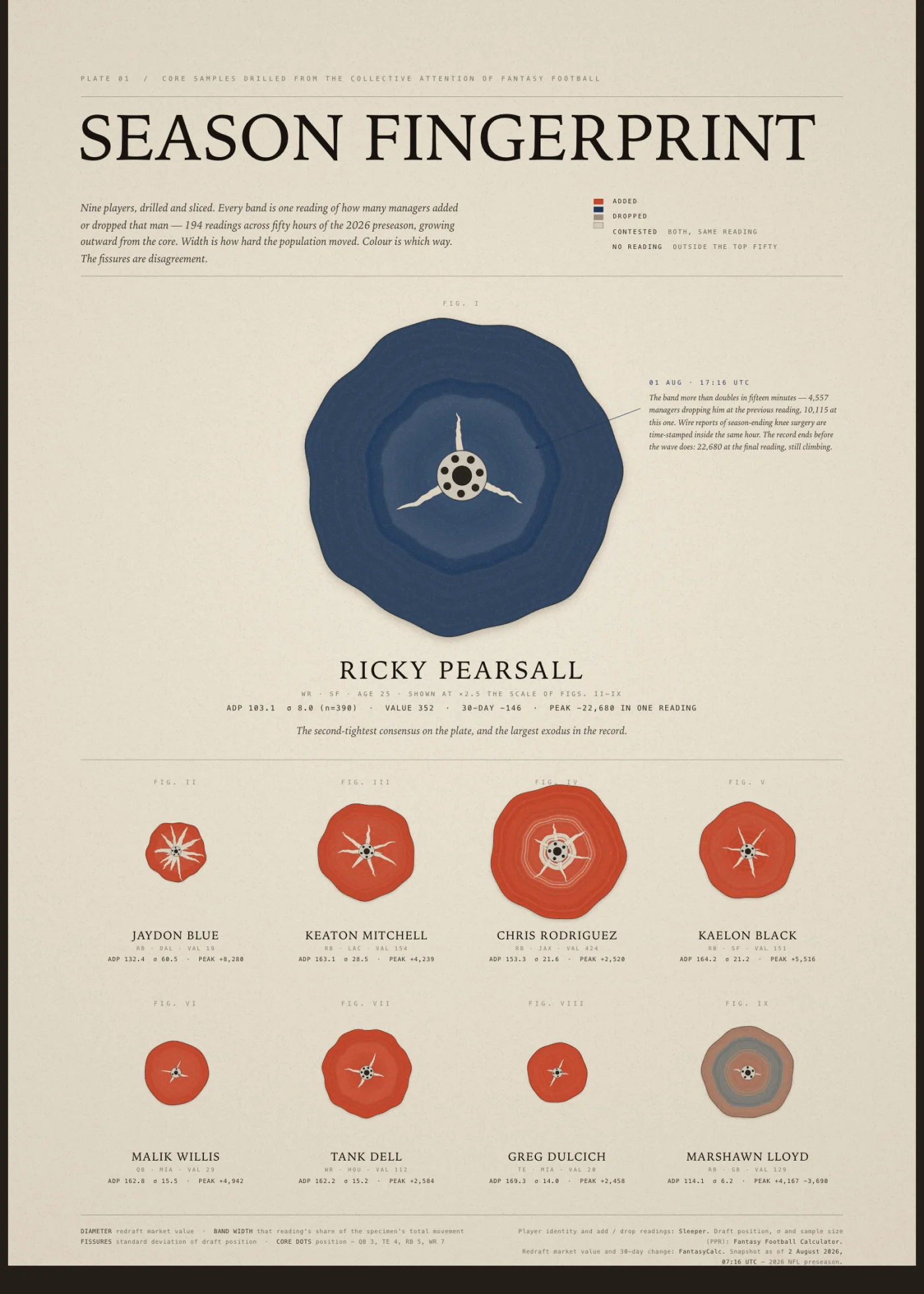
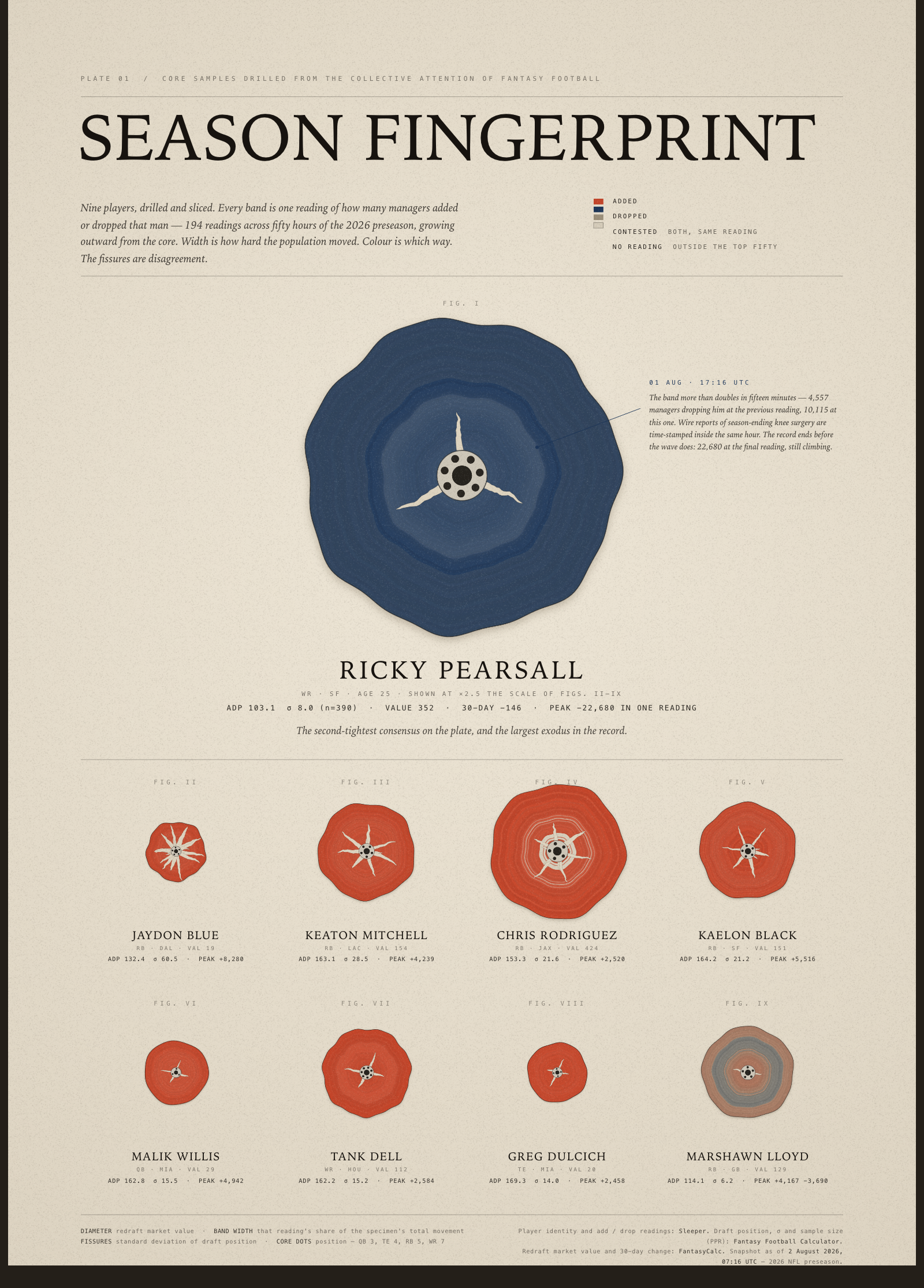
Fig. I — the hero core
22,680 in one readingRicky Pearsall, drawn at ×2.5 the scale of the eight below so that the banding can be read at all. Prussian the whole way out: he carries a drop reading at every one of the 194 captures, and the outermost band is the largest single reading in the entire drop file.
The annotation, 01 August
4,557 → 10,115His low for the window is 3,689 at 16:31. Five wire items land between 16:55 and 17:02, and the 17:01 reading has barely moved. The next reading, fifteen minutes later, has more than doubled. The record ends before the wave does.
The key
Four states, one axisVermilion is being added, prussian is being dropped, taupe is both inside the same fifteen-minute window, and the hollow swatch is a reading outside the top fifty. Saturation carries magnitude, so a faint band is a small reading rather than a missing one.
Fig. II — the fissures
σ 60.5, on seven draftsFissure count and width are read off the standard deviation of draft position, which makes Jaydon Blue the most broken object on the sheet. One of his seven recorded drafts took him first overall and another let him go at 195. Seven drafts is the thinnest evidence anywhere on the plate.
The grid of eight
Seven of eight, one colourSeven of the eight specimens mounted under the hero have no drop reading anywhere in the 194 captures, so seven discs are the same vermilion with the same slow drift in ring width. That is a fact about how the nine were chosen — the argument is below.
Fig. IX — contested
194 of 194, both waysMarShawn Lloyd is added and dropped at every capture, which is why his core is taupe rather than either colour. Drops outnumber adds at 68 of the 194 readings. The drafting public is not confused about where to take him: σ 6.2 is the tightest consensus in the eligible thirteen.
How the nine were chosen
The sheet describes itself as core samples drilled from the collective attention of fantasy football. It is not that, and the difference is worth stating plainly. The drawing needs three numbers for every specimen: a market value for the diameter, a standard deviation of draft position for the fissures, and a run of add/drop readings for the bands. 103 players appear in the trending record over these fifty hours. 13 of them carry all three. Nine of those thirteen were mounted.
The constraint is severe enough to exclude the loudest event in the file. The largest single reading anywhere is 135,114 managers adding Cyrus Allen at 17:31 on 1 August. Allen has a market value but no drafting record, so there is no fissure geometry for him and he cannot be drawn.
Inside the thirteen, ten have no drop reading at all across the window. That is a real property of the pool, and it means any nine drawn from it will lean vermilion. But the nine on the sheet also leave out the pool's only add-free specimen — Kimani Vidal, dropped at all 194 readings and added at none — so the plate ends up more uniform than even its own small population. The grid reads as repetition because the selection made it repetitive.
103 players appear in the trending record across the fifty-hour window
13 of them carry both a market value and a draft position, which is what the drawing requires
10 of 13 have no drop reading anywhere in the window, so their signature is one colour by construction
Re-cut for range
Same rule, same thirteen, a different seven — chosen because their signatures differ from one another rather than because they are the largest. Nothing has been relaxed to get here: every specimen below still carries its own market value, its own draft position and its own series of 194 readings, cut and coloured by the same law as the printed sheet.
All seven are drawn at one scale, so their diameters can be compared directly against each other. The printed plate magnifies its hero two and a half times; nothing here is magnified.
Fig. I
Kimani Vidal
ADP 163.7 σ 18.9 (n=6) · peak −3,990
Fig. I · The omission
194 drop readings, no addsDropped at every capture in the window and added at none of them: the only specimen in the eligible thirteen with no vermilion anywhere in it, and the one the printed sheet does not carry. Nothing dramatic happens to him. The band holds between 2,425 and 3,990 for fifty hours — a steady, unanimous walking-away.
Fig. II
Ricky Pearsall
ADP 103.1 σ 8.0 (n=390) · peak −22,680
Fig. II · The exodus
3,689 → 22,680The tightest draft consensus in the pool and the largest exodus in the record, in one object. 390 drafts place him inside σ 8.0. Then the drop reading, sitting at its low of 3,689 at 16:31 on 1 August, more than doubles inside a single fifteen-minute gap and ends the file at 22,680, still climbing. Adds appear for the first time at reading 155 of 194 — the replacement traffic arriving behind the wave, drawn as the contested rim.
Fig. III
MarShawn Lloyd
ADP 114.1 σ 6.2 (n=8) · peak +4,167 −3,690
Fig. III · Contested
194 of 194, both directionsAdded and dropped at every single reading, which is what makes the core taupe rather than either colour. This is not opinion changing over two days; it is disagreement inside each quarter of an hour. Drops outnumber adds at 68 of the 194 readings — and the disc still has the least fissuring in the set, because σ 6.2 across eight drafts is the tightest consensus the pool contains.
Fig. IV
Jaydon Blue
ADP 132.4 σ 60.5 (n=7) · peak +8,280
Fig. IV · Fractured
Pick 1 to pick 195Fissures are read from the standard deviation of draft position, so at σ 60.5 this is the most broken specimen in the pool — a disc barely larger than the control and split open across most of its radius. The seven recorded drafts include one that took him first overall and one that let him fall to 195. Not one manager dropped him in 194 readings.
Fig. V
Chris Rodriguez
ADP 153.3 σ 21.6 (n=67) · peak +2,520
Fig. V · The gap
Absent from 84 of 194The largest disc in the set by market value, and the only one with holes in it. Sleeper publishes the fifty players moving hardest; a player moving less than that is simply not in the file. Rodriguez leaves after the third reading and stays out for 49 consecutive captures. The pale rings are not indifference — they are the absence of a measurement, and they are drawn at a fixed width because there is no width to draw.
Fig. VI
Kaelon Black
ADP 164.2 σ 21.2 (n=8) · peak +5,516
Fig. VI · Decay and return
5,516 → 2,835 → 4,438The one specimen whose attention visibly runs down and comes back. Adds peak at 5,516 in the third reading, fall by 49% over the next thirty hours, and recover to 4,438 by the end of the file. Band width is share of total movement, so the arc shows up as a slow narrowing and re-widening of the rings rather than as any change of colour.
Fig. VII
Greg Dulcich
ADP 169.3 σ 14.0 (n=13) · peak +2,458
Fig. VII · The control
1,766 to 2,458, and nothing elseAcross fifty hours the reading never falls below 1,766 or rises above 2,458 — a 28% spread between the narrowest and widest band, the flattest single-direction signature in the thirteen. Even rings, a small disc, four short fissures. This is the fingerprint of a player nobody is reconsidering, and it is the reason the other six are worth drawing.
What is measured and what is drawn
The variables. Diameter is redraft market value on a square-root scale with a floor — radius = 52 + 66.1 × (√v − √19) ⁄ (√424 − √19) — which ranks value truthfully and keeps the smallest specimen legible, but is deliberately not proportional to value. Band width is that reading's share of the specimen's total movement across the window. Colour is direction and saturation is magnitude, measured against that specimen's own largest reading, so saturation is never comparable between specimens. The number of fissures is 1 + σ ⁄ 4.5, rounded, and their reach and width scale with σ against the pool's widest, 60.5. The number of lobes in the outline and of dots in the core is the position group: 3 quarterback, 4 tight end, 5 running back, 7 wide receiver.
What is a composition device. The rotation of the lobed outline, the starting angle of each fissure, the shorter twin cracks on the most-split specimens and a colour jitter of ±3.5% per band carry nothing. They are generated from a fixed seed derived from the player's Sleeper id, so a given specimen always draws identically. Nothing on this page is randomised at view time.
Absence is not zero. Sleeper publishes the fifty players moving hardest at each reading. A capture with no row is a player outside that fifty, not a player nobody touched. Those bands are drawn pale and at a fixed 30% of the specimen's mean band width, which is a legibility choice and carries no magnitude at all.
The σ figures rest on very different samples. Draft position and its standard deviation come from Fantasy Football Calculator's PPR pool, and the sample behind them ranges from 390 drafts for Pearsall to 6 for Vidal and 7 for Blue. A σ built on seven drafts is a far weaker statement than one built on 390, and the drawing cannot tell them apart — which is why every specimen prints its own sample size beside its σ.
Scope, and what this plate claims. 194 readings between 31 July 05:28 and 2 August 07:16 UTC, 2026 preseason, PPR. The seven specimens above are a selection chosen to span the behaviours in the eligible pool. They are not a sample of the population, they are not the largest movers, and no aggregate on this page should be read as describing fantasy football as a whole.
Where these numbers come from
Sources & freshness
- Sleeper — trending add/drop02 Aug 07:16
- Sleeper — news wire02 Aug 07:16
- FantasyCalc — redraft values02 Aug 06:56
- FantasyFootballCalculator — PPR ADP02 Aug 05:31
- Sleeper — player universe02 Aug 05:31
The queries
The plate's own five statements are printed in full in its HTML header:
Q1 the 194-reading timeline, Q2 the
eligible thirteen, Q3 the per-specimen ring series,
Q4 snapshot freshness, Q5 the dated wire
items behind the fig. I annotation. The re-selection on this page adds one
more, run against data/snapshot.sqlite3 opened read-only.
The rails
- Every printed figure is query output.
- No league marks, logos, or photographs.
- Nothing is fetched at view time.
- Deterministic: seeded geometry only.
-- Q6. The eligible thirteen, each with its own signature.
-- This is the query the re-cut above was selected from.
SELECT p.name, p.position, v.value, a.adp, a.stdev, a.times_drafted AS n,
COUNT(DISTINCT t.captured_at) AS readings,
SUM(t.kind='add' AND t.count > 0) AS add_readings,
SUM(t.kind='drop' AND t.count > 0) AS drop_readings,
MAX(CASE WHEN t.kind='add' THEN t.count END) AS peak_add,
MAX(CASE WHEN t.kind='drop' THEN t.count END) AS peak_drop
FROM players p
JOIN player_values v ON v.sleeper_id = p.sleeper_id AND v.format = 'redraft'
JOIN adp a ON a.sleeper_id = p.sleeper_id AND a.scoring = 'ppr'
JOIN trending t ON t.sleeper_id = p.sleeper_id
GROUP BY p.sleeper_id
ORDER BY drop_readings DESC, add_readings DESC;